Now Welcoming New Patients

Water Flosser vs. Traditional Floss: Which One Actually Wins?
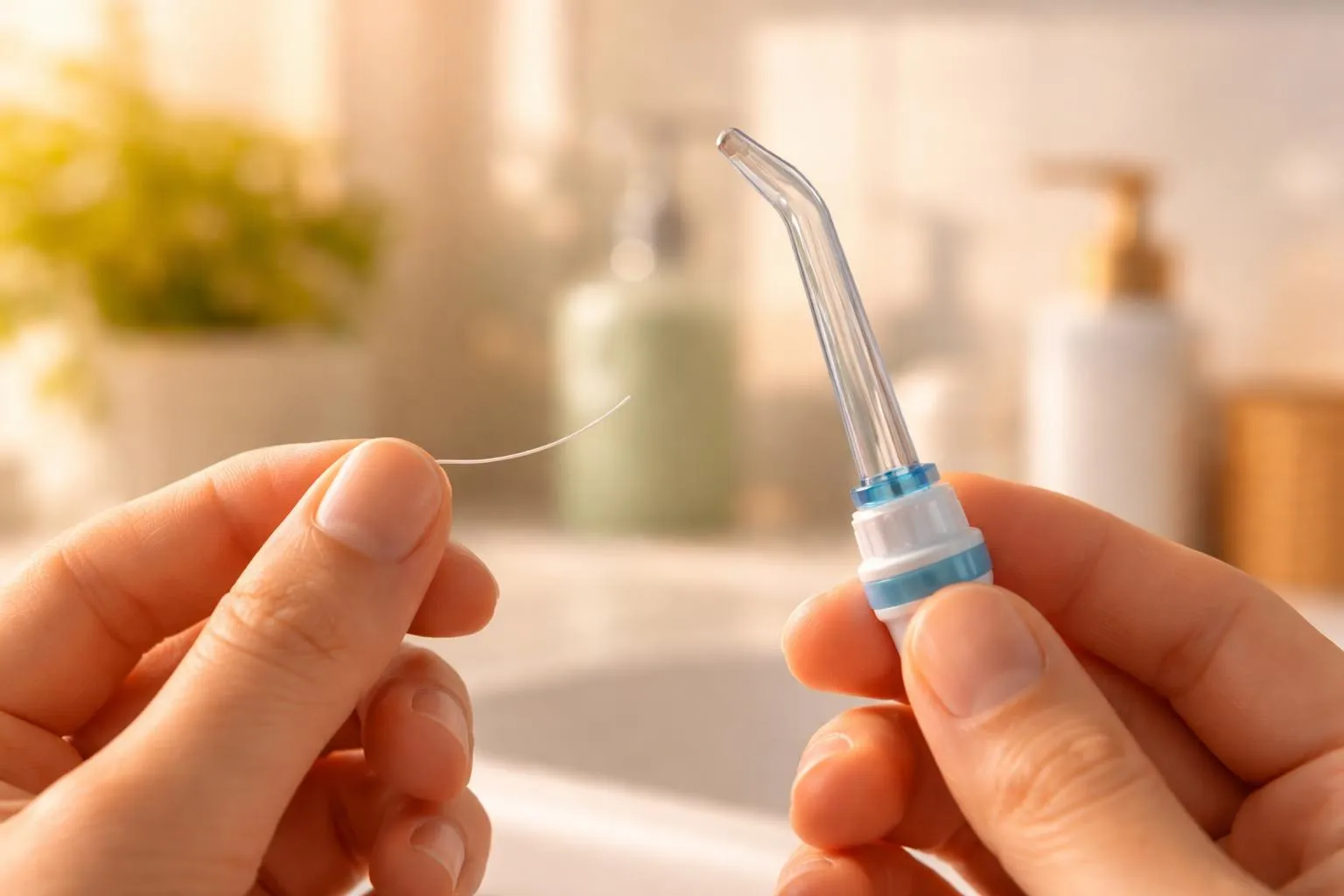
People want a clean winner here. One tool. One right answer. One thing to buy and feel done.
I get it. Oral hygiene already asks a lot of us. Brush well, floss daily, watch the sugar, book the checkup, maybe wear the night guard too. So when the question is “water flosser or string floss?”, it would be nice if the answer were simple.
It isn’t, but it is clearer than it seems.
The short version is this: traditional floss is still excellent at scraping plaque off the sides of teeth. A water flosser is often easier to use and can be a very good option for people with braces, bridges, dental implants, gum problems, or limited hand control. If you use both, great. If you will only use one, the best choice is the one you will use correctly and consistently.
That may sound like a dodge. It’s really not. In dental care, perfect technique done twice a year does less than a good-enough habit done every night.
Why this question matters in the first place
A toothbrush does not clean everything. It cleans the front, back, and chewing surfaces of your teeth fairly well. What it misses are the tight spaces between teeth and the area just under the gumline. That’s where plaque likes to hang around.
Plaque is a sticky film of bacteria. If it stays in place, it can irritate the gums and lead to bleeding, tenderness, and bad breath. Over time, it can harden into tartar, which you cannot brush away at home. If things keep going in the wrong direction, cavities can form between the teeth, and gum disease can start to damage the tissue and bone that support them.
So this debate is not about gadgets. It is about whether you are actually removing plaque where a toothbrush cannot reach.
What traditional floss does well
Traditional floss works by physically scraping plaque and food debris off the sides of the teeth. That scraping matters. When floss is wrapped around the tooth in a C-shape and guided gently below the gumline, it cleans an area that a brush simply does not touch well.
Used properly, floss is precise. It can clean tight contact points and narrow spaces very effectively. It is also cheap, portable, and easy to keep in a bag, desk, or bathroom drawer.
That said, “used properly” is carrying a lot of weight in that sentence.
A lot of people snap floss straight down, pop it back up, and call it done. That is not really flossing. It is more like bothering your gums for a few seconds. Proper flossing takes a bit of coordination and patience, especially around back teeth.
Traditional floss often wins when:
Your teeth are tightly spaced
You have healthy hand control and can use good technique
You want a low-cost option
You travel often and want something simple
You are trying to clean very specific contact points
Traditional floss is harder when:
You have braces or wires
You have a fixed bridge
You have larger hands or limited dexterity
You have arthritis, tremors, or mobility challenges
You tend to skip floss because it feels tedious
And that last point matters more than people admit. A tool can be excellent in theory and useless in practice if you avoid it every night.
What a water flosser actually does
A water flosser uses a narrow stream of pulsating water to flush around the gumline and between teeth. It does not scrape tooth surfaces in quite the same way as string floss, but it can disrupt plaque, wash away loose debris, and reduce bleeding and gum inflammation when used regularly.
For some people, water flossers feel easier from the first day. That is a big deal. Less fumbling. Less awkward wrist positioning. Less frustration around braces, retainers, crowns, and implants.
They can also reach around dental work that makes string floss annoying or complicated. If you have a bridge, orthodontic appliance, or certain types of restorative dentistry, a water flosser often feels much more realistic as a daily habit.
Water flossers often win when:
You have braces or permanent retainers
You have dental implants
You have bridges, crowns, or other restorative dentistry
Your gums bleed easily or feel tender
You have early gum disease or deeper pockets
You have limited hand strength or coordination
You are helping a child, teen, or family member with special needs
Water flossers are less ideal when:
You want the lowest-cost option
You need something very portable
You want a completely mess-free routine
You prefer the direct scraping action of floss on tight contacts
There is also a learning curve. The first few uses can be a little splashy. Most people figure it out quickly, but your bathroom mirror may have opinions.
So which one is better according to the evidence?
Here is the honest answer a dentist would usually give: traditional floss is extremely good at mechanical plaque removal between teeth, but water flossers perform very well in real life, especially for gum bleeding, inflammation, braces, and complex dental work.
That distinction matters.
If someone has excellent floss technique and does it every day, string floss is hard to beat. But plenty of people do not floss well, and many do not floss at all. For those people, a water flosser can be a meaningful upgrade because it is easier to stick with.
In other words, the “best” tool on paper is not always the best tool in a bathroom at 10:30 p.m. when you are tired and just want to go to bed.
A side-by-side comparison
CategoryTraditional FlossWater FlosserPlaque removal on tight tooth surfacesVery strongGood, but different actionEase of useModerate to difficult for someOften easierBest for bracesAwkward without aidsVery goodBest for implants and bridgesCan be trickyVery goodCostLowHigher upfrontTravel convenienceExcellentLess convenientMess factorLowModerate at firstGood for limited dexterityOften challengingOften betterGum bleeding/inflammationHelpful if used wellOften very helpfulLearning curveTechnique-sensitiveSetup-sensitive
A table like this can make it look like water flossers are pulling ahead. Sometimes they are. But if your teeth are very tight and you are already good at flossing, you may still prefer traditional floss.
Who should consider a water flosser first?
Some groups benefit so clearly that the decision is almost made for them.
People with braces or permanent retainers
String floss around orthodontic wires is possible, but it is slow. You can use floss threaders or special orthodontic floss, but many teens and adults simply stop doing it regularly. A water flosser makes cleaning around brackets and wires much easier.
For families dealing with pediatric dentistry or teen orthodontic care, this can be the difference between “we keep meaning to floss” and “we actually do it.”
People with dental implants, bridges, or crowns
Dental implants and bridges create shapes and spaces that can trap plaque and food. These areas need regular cleaning to protect the gums and the supporting structures. Water flossers are often very useful here, especially when paired with the advice of a dentist or hygienist.
If you have had restorative dentistry, cleaning around that work is not optional. It protects the investment and helps prevent inflammation and decay around adjacent teeth.
People with arthritis, tremors, or limited dexterity
This is a big one. String floss assumes a fair amount of hand control. For people with reduced mobility, a water flosser can make daily cleaning realistic again. That matters for adults, seniors, and patients with special needs.
People with gum inflammation
If your gums bleed when you clean between your teeth, that does not automatically mean you should stop. In many cases, it means you need better plaque removal, not less. Water flossers can be very helpful for people with gingivitis or tenderness because they are effective but often feel gentler.
If bleeding is heavy, persistent, or painful, it is worth bringing up at your next dental care visit.
Who may still prefer traditional floss?
Traditional floss still makes a lot of sense for many people.
People with very tight contacts
Some teeth sit close together in a way that makes the scraping action of floss especially useful. A water flosser may flush the area, but string floss can feel more thorough.
People who already have a solid routine
If you floss every night, your gums are healthy, and the habit does not bother you, there is no reason to abandon what works. You do not get a prize for making a good routine more complicated.
People who want simplicity
No charging. No refilling. No machine on the counter. No hose, no tips, no splashing. Just floss.
That kind of simplicity keeps habits alive.
If you can only choose one, ask yourself these questions
This is usually where the decision gets practical.
Will I really use string floss every day?
Do I have braces, bridges, implants, or crowns?
Do my gums bleed often?
Do I struggle with hand strength or coordination?
Am I buying this for a child or teen who already resists flossing?
Do I want the easiest tool, or the cheapest one?
If your answer is, “I know floss is effective, but I never do it,” then a water flosser may win for you. Real compliance beats ideal intentions.
How to use traditional floss properly
Technique changes everything.
Use about 18 inches of floss.
Wrap most of it around your middle fingers, leaving a short section to work with.
Guide it gently between the teeth. Do not snap it down.
Curve it around one tooth in a C-shape.
Slide it up and down against the side of that tooth and slightly under the gumline.
Repeat on the neighboring tooth before moving on.
Use a clean section as you go.
If regular floss feels awkward, floss picks can help some people, though they are not always as precise as string floss. For bridges or orthodontic wires, a floss threader may help.
How to use a water flosser well
Water flossers are easy to start using, but a few small adjustments make them much better.
Fill the reservoir with lukewarm water.
Lean over the sink before turning it on.
Start with a lower pressure setting if your gums are sensitive.
Place the tip in your mouth first, then turn the unit on.
Aim along the gumline, not just at the center of the tooth.
Pause briefly between teeth.
Clean the inside surfaces too, especially on lower front teeth.
Empty and dry the device when finished.
Some people like to use a water flosser before brushing. Others prefer it after. Either is fine if you are thorough.
Can you use both?
Yes, and for some people that is the best setup.
If you are detail-oriented and want a very complete routine, you can use string floss for the tight contact points and a water flosser for the gumline, braces, implants, or bridgework. That is especially useful if you have mixed needs, such as naturally tight teeth plus dental implants or crowns.
But I would not push a two-tool routine on someone who already struggles to do one. Keep the habit realistic.
A few situations where you should ask your dentist
Home tools are useful, but they are not one-size-fits-all.
You should ask a dentist or hygienist for specific advice if:
Your gums bleed for more than a week or two after improving your routine
One spot always catches food
You have loose dental work
You have gum recession or sensitive roots
You recently had oral surgery
You are healing after a tooth extraction
You have had endodontics and want to know how to clean around the treated tooth
You have new dental implants, a bridge, or other restorative dentistry
You are helping a child learn flossing habits
After oral surgery, the instructions can be very specific. The same goes for healing around implants or certain endodontics cases. That is one area where generic internet advice is not good enough.
What about whitening, bad breath, and “feeling cleaner”?
This comes up a lot.
A cleaner mouth often looks better too. Removing plaque and food debris can help teeth appear brighter simply because there is less buildup dulling the surface. That is not the same thing as teeth whitening, but it does improve the overall look of your smile.
It also helps with breath. Food trapped between teeth and inflamed gums both contribute to bad breath. Interdental cleaning, whether with floss or a water flosser, can make a real difference there.
And yes, many people say a water flosser makes their mouth feel cleaner. That feeling is not meaningless. If a tool gives you immediate feedback and makes you more likely to use it tomorrow, that matters.
The real winner
Here is the least glamorous answer and probably the truest one: the winner is the tool you will use properly, every day, on the surfaces your toothbrush misses.
Traditional floss still has a strong case. It is precise, inexpensive, and excellent at scraping plaque from tight spaces.
Water flossers have a strong case too. They are often easier to use, especially for braces, dental implants, gum problems, and people who find string floss frustrating or physically difficult.
If you want a simple rule, use this one:
Choose traditional floss if you already do it well and your mouth is easy to floss.
Choose a water flosser if it will make daily cleaning more likely, more comfortable, or more thorough.
Use both if you like and if you will actually keep it up.
That is the real test in dental care. Not what wins the argument, but what survives real life.